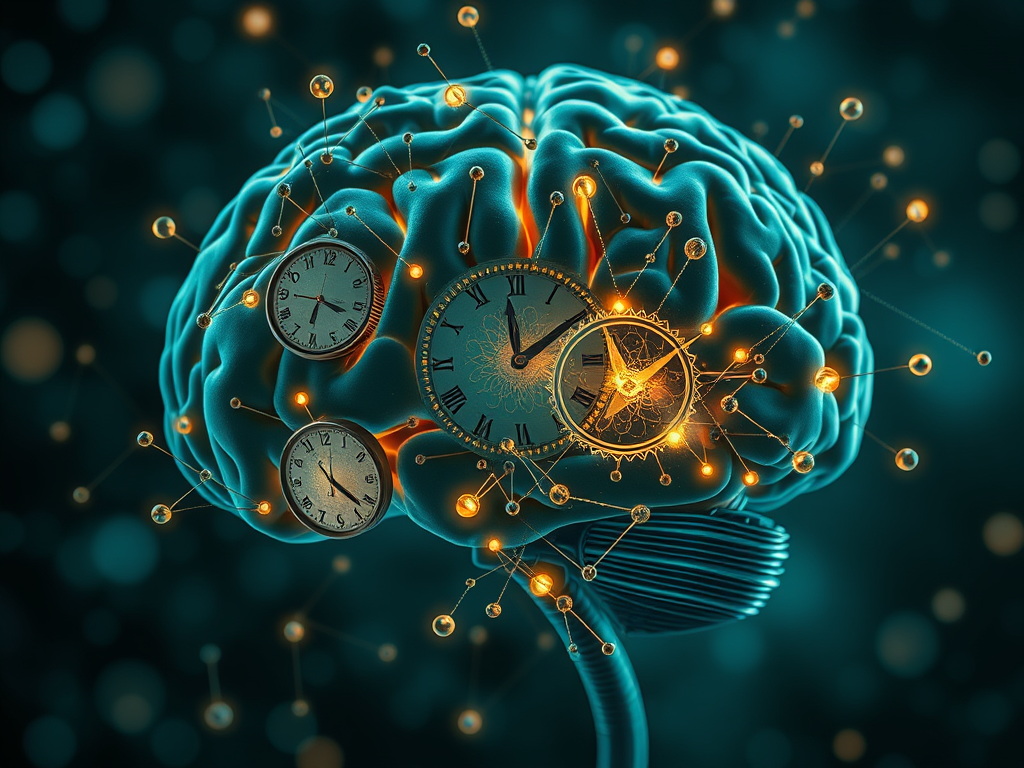
We’ve all experienced the longest maths lesson of our life – 10 minutes seem to take one hour, but then it’s lunch and before you know it, back to lessons.
Why do our brains perceive time in this, honestly, frustrating way?
Time perception: controlled entirely by the brain – not the clock.
The brain doesn’t have a time organ- it estimates time
Unlike vision (eyes) or hearing (ears), the brain doesn’t have a single organ specifically for time. Instead, time perception comes from multiple brain regions working together:
Prefrontal cortex
Judges the duration and keeps track of time in the working memory.
Basal Ganglia
Generates your internal ‘beat’ used for timing seconds. It receives rhythmic neural signals and measures small intervals (seconds), heavily influenced by dopamine.
Cerebellum
Handles very fast, millisecond timing (speech, movement). It even helps your brain predict the next moment.
Hippocampus
Stores memories that anchor your sense of how long things have lasted. It contains neutrons called time cells, which activate in sequence to create a sense of time.
Amygdala
Changes timing during strong emotions like fear or excitement
(make sure to just click on the arrows for more information)
These all come together to create a ‘time network’, and is what leads to time feeling flexible.
The brain measures time with patterns, not a clock
Researchers think the brain measures time in two main ways:
- The ‘Internal Pacemaker’ idea
Your brain may have an internal rhythm — a bit like a mental metronome. When you focus on time, this rhythm becomes louder or quieter
- When it speeds up → time feels longer
- When it slows down → time feels shorter
Dopamine plays a big role in this pacemaker (more on that later)
2. The Changing Brain-State Theory
Instead of pulses, this view suggests your brain tracks time by monitoring how its activity patterns evolve.

Imagine a lava lamp – the shapes constantly shift. In our brain, the pattern changes aren’t random – they follow predictable dynamics and patterns.
Your brain can ‘read’ the current pattern and estimate how much time has passed. So a small change in pattern would feel like a short time and vice versa
Time cells in the hippocampus aid this theory, as the neurons fire in a specific order across seconds. These create a natural ‘timeline’, showing that time is encoded in the progression of network states.
This also explains time distortion: neural state changes faster or slower depending on attention, emotion and novelty, explaining why time feels different in different situations
Why time sometimes feels slow
We’ve all had days or moments that feel like they last forever. Here’s the science behind it. (click through them)
When nothing interesting is happening, you become hyper-aware of yourself and your surroundings.
Your brain processes more internal details, which creates more “mental timestamps.”
More timestamps = slower time.
Novelty forces the brain to work harder and store richer memories.
This is why the first day of school or a new job feels long, while familiar days fly by.
During intense events — a fall, a near accident, a shock — the amygdala becomes highly active and stores more detail.
This creates the illusion of slow motion.
When you’re not doing much — like waiting, sitting in a boring lesson, or doing an easy task — your brain has extra attention available.
With nothing to focus on, it starts paying attention to time itself.
Case study: How Fear Distorts Time
A 2021 fMRI study showed that when people viewed threatening images, they felt the images lasted longer than neutral ones – even though the duration was identical
Scans revealed that:
- The amygdala (fear centre) became highly active, sharpening attention and stretching time.
- The insula detected increased arousal (faster heartbeat, alertness), making the brain’s “internal clock” speed up.
- The putamen fired more rapidly, adding more internal time pulses.
These brain changes created stronger, more detailed memories, which also made the moments feel longer when recalled.
You can read more about the experiment here.
Why time often feels fast
On the opposite end, some days disappear instantly
When your days look the same, the hippocampus stores fewer unique memories.
Your brain compresses repetitive days together, so they seem to pass quickly.
During deep focus (sports, writing, gaming, art), the prefrontal cortex quiets down.
You stop monitoring time and are so entranced in what you’re doing, you forget it even exists
Adults experience fewer “firsts,” so the brain encodes fewer rich memories.
This makes years seem shorter as you age.
Why time feels unreal or distorted
Sometimes time doesn’t feel fast or slow – it feels strange.
This happens when the brain systems responsible for attention and sensory processing become unstable
Stress Hormones
When you’re under stress, your body releases cortisol and adrenaline.
These chemicals shift the brain into “survival mode.”
They disrupt normal activity in the prefrontal cortex and the hippocampus.
This can cause:
- moments to feel stretched or jumpy
- time to ‘skip’
- ‘events to feel less connected’
Your brain becomes focused on threat, not accurate timing.
Anxiety
Anxiety speeds up your internal timing circuits, especially in the basal ganglia, which are sensitive to dopamine.
- This makes your internal pacemaker tick faster than normal.
- Faster internal clock = moments feel too long or too intense.
- Time may feel shaky, overwhelming, or “too full” because your brain is over-monitoring everything.
Dissociation
During emotional overload, the brain sometimes pulls back to protect you.
It reduces sensory input and disconnects attention from the present moment.
This leads to:
- time feeling unreal
- everything feeling distant or muted
- moments losing their structure or flow
Dissociation reduces the brain’s “recording,” so time becomes blurry and hard to judge.

The brain chemical that controls the speed of time
Dopamine is one of the biggest influences on how fast or slow time feels because it affects the basal ganglia, the area responsible for timing and internal rhythms.
High Dopamine = Fast Internal Clock
When dopamine is high, your internal timing circuits speed up
Your brain counts more pulses per second, so the same amount of real time feels shorter
This happens during :
excitement
fun or immersive activities
video games
novelty and new experiences
anticipation or reward
Why childhood feels long but adulthood feels fast
1. More Novelty in Childhood
Children are constantly experiencing “firsts” — first school, first friends, first holidays, first memories.
New experiences produce rich, detailed memories, which the brain uses to judge time.
More memories = longer-feeling years.
2. Higher Brain Plasticity
Children’s brains form connections quickly.
Because of this, they encode:
- more detail
- more sensory information
- more emotional context
This increases the number of “time markers,” making childhood feel longer and fuller.
3. The Proportional Effect
A year at age 10 feels huge because it’s 10% of your life.
A year at 30 is only 3% of your life.
As the ratio shrinks, each year feels proportionally shorter.
4. Adults Have More Routine
Adulthood includes repeated patterns: work, school, chores, responsibilities.
Routine days create fewer unique memories, so the brain compresses them.
Fewer memories = the years feel like they’re speeding up.
Time isn’t just something we measure with clocks – it’s something the brain actively constructs, resulting in it sometimes feeling a little elastic
Understanding these mechanism don’t just explain why life sometimes speeds up, slows down, or feels unreal — it shows just how deeply our perception is tied to our biology.
Leave a Reply